




Wednesday, 12 August 2026 10:55 AM
Product Announcements
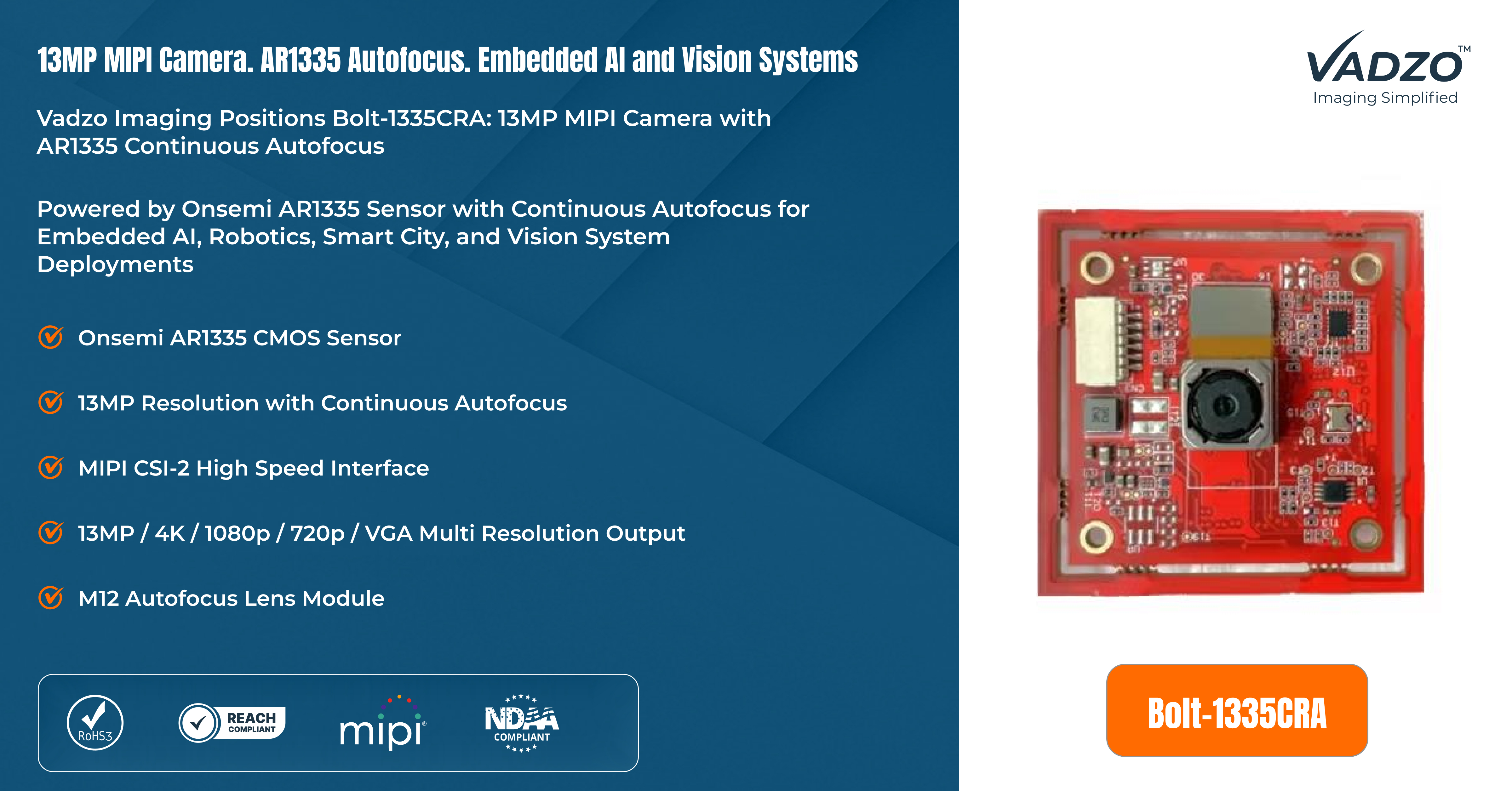
The Bolt-1335CRA is a 13MP autofocus MIPI camera module built around the Onsemi AR1335 sensor. It is designed for embedded AI, robotics, smart city, and vision system platforms that need a sharp, high-resolution frame delivered directly into the host processor without added interface overhead.
FORT WORTH, TX / ACCESS Newswire / August 12, 2026 / Vadzo Imaging makes embedded vision camera products for OEMs and system integrators. Today, the company positioned the Bolt-1335CRA for embedded AI and vision system deployments. This is a 13MP MIPI Camera built on the Onsemi AR1335 sensor with continuous autofocus and a direct MIPI CSI-2 connection to the host processor.
The Interface and Focus Bottleneck in Embedded AI Vision Systems
Embedded AI systems are only as good as the frames they receive. A camera module that introduces latency, inconsistent focus, or unnecessary board complexity limits what an inference pipeline can achieve and how capable the underlying model is. An AR1335 MIPI Camera addresses two of these limitations directly by pairing continuous autofocus with a native MIPI CSI-2 connection instead of routing frames through an intermediate USB stage.
Fixed focus modules force a system integrator to choose one working distance and accept degraded sharpness outside that range, which is a problem for robotics platforms and vision systems that operate at variable distances from their subject. An AR1335 Autofocus MIPI Sensor removes that constraint at the optical level, so the AI model downstream always receives a properly focused frame.
Sensor and Interface Architecture Behind the Bolt-1335CRA
The Bolt-1335CRA is built around the Onsemi AR1335 MIPI Camera sensor, a 1/3.2 inch Back-Side Illuminated CMOS device with a 1.1-micron pixel pitch that delivers full 13MP resolution at 4208 by 3120 pixels. As an AR1335 4K MIPI Camera, the module can also output a downsampled 4K stream from the same sensor pipeline for applications that do not need the full 13MP frame.
Continuous autofocus is handled by a voice coil motor lens actuator commanded through standard control registers, so the module functions as an AR1335 MIPI Sensor Module capable of holding focus automatically as the working distance changes. This matters directly for an AR1335 Embedded AI Camera deployment because an AI model trained on sharp reference images loses accuracy quickly when the live feed drifts out of focus.
Rather than routing image data through a USB controller, the Bolt-1335CRA exposes its output directly over a MIPI CSI-2 interface configurable across 2-lane or 4-lane implementations depending on the host platform. This removes an intermediate serialization stage from the capture path, which lowers latency between sensor readout and the frame reaching the AI inference engine. A 13MP Autofocus MIPI Camera built this way keeps the entire capture-to-inference path as short as possible.
The AR1335 sensor uses a rolling shutter readout suited to the framing patterns typical of fixed robotics stations and embedded vision inspection points. The module supports device tree-based integration on common embedded Linux platforms, so an MIPI Autofocus Camera can be brought online without a custom driver written from scratch.
Introducing the Bolt-1335CRA Autofocus MIPI Camera Platform
The Bolt-1335CRA is Vadzo Imaging's newest addition to its Bolt MIPI camera series and its first entry positioned specifically for embedded AI and vision system deployments. As a 13MP MIPI Camera, the module pairs the Onsemi AR1335 sensor with a factory-calibrated continuous autofocus lens in a compact form factor built for direct integration into an embedded AI host board.
System integrators building an Autofocus MIPI Sensor deployment need more than a datasheet resolution number. They need consistent focus, low latency, and a driver stack that works on the first attempt. Positioned as a MIPI CSI-2 Autofocus Camera, the Bolt-1335CRA functions as a High Resolution MIPI Autofocus Camera and a Fast Autofocus MIPI Camera suited to embedded AI pipelines that cannot afford a slow or unreliable capture stage.
Real Time Dynamic ROI Streaming for Bandwidth-Constrained Pipelines
Full-frame 13MP output at full frame rate is rarely what an embedded AI pipeline actually needs from every frame. The Bolt-1335CRA supports Dynamic ROI streaming directly at the sensor level, letting the host define and shift a region of interest in real time without re-negotiating the MIPI stream or dropping frames. Functioning as a Dynamic ROI MIPI Camera, the module lets integrators track a moving subject or a fixed inspection zone at full sensor resolution while cutting the data rate that would otherwise be spent streaming the rest of the frame. Because the windowing happens on the AR1335 sensor itself rather than through a software crop downstream, the reduced-bandwidth stream carries no compression or scaling penalty.
ROI-Based Autofocus for Subject-Locked Sharpness
A continuous autofocus system that focuses on whatever sits at frame center works poorly when the subject of interest is off-axis or moving. The Bolt-1335CRA supports ROI-based autofocus, allowing the host to designate a specific region within the frame as the focus target instead of relying on a fixed center-weighted zone. As an ROI Autofocus MIPI Camera, it keeps a defined inspection area, tracked object, or operator-selected zone in sharp focus even as other regions of the scene move in and out of the depth of field.
ROI-Based Auto Exposure for Scene-Aware Metering
A single global exposure value struggles in scenes with mixed lighting, where the region an AI model actually needs to read is underexposed or blown out relative to the rest of the frame. The Bolt-1335CRA supports ROI-based auto exposure, metering off a host-defined region rather than the full frame average. Built as an ROI Auto Exposure MIPI Camera, it lets integrators lock correct exposure onto a license plate, a conveyor inspection window, or a badge-reader zone regardless of what the background is doing.
Continuous Autofocus for Consistent AI Input
An inference model trained on sharp reference images degrades quickly when the live feed drifts out of focus. The Bolt-1335CRA solves this with a continuous autofocus lens that tracks focus automatically as the working distance changes. Functioning as a 13MP MIPI Sensor, the module keeps every frame reaching the AI pipeline consistently sharp without operator intervention.
High Resolution Capture for Deep Learning Accuracy
Deep learning models trained for classification and detection perform better with more pixel detail per feature. A 4K MIPI Autofocus Camera mode balances that detail against bandwidth for real-time inference while the full 13MP capture mode services great detail review. Built as a Deep Learning MIPI Camera, the Bolt-1335CRA gives model training and inference pipelines a richer source frame to work with before any digital cropping or scaling reduces the effective resolution.
Multi-Resolution Output for Embedded AI Pipelines
Not every stage of an embedded AI pipeline needs full resolution. The Bolt-1335CRA exposes 13MP, 4K, 1080p, 720p, and VGA output modes from the same sensor pipeline as a 13MP MIPI Camera Module, so a single hardware platform can serve a great detail capture stream and a lightweight inference stream at once. As a 4K MIPI Camera Module, it also fits deployments that only need the downsampled 4K output without the full 13MP frame.
MIPI CSI-2 Direct Embedded Integration
The Bolt-1335CRA connects to any MIPI CSI-2 host port on Raspberry Pi, NVIDIA Orin NX, Nvidia Orin Nano, Nvidia Orin AGX, NXP i.MX8, and Rockchip platforms without a USB bridge board. Functioning as an Embedded AI Camera delivers frames directly into the host image pipeline. As an MIPI Embedded AI Camera, it ships with Linux V4L2 drivers and device tree overlays ready for immediate integration.
Compact OEM Ready Module Design
OEM engineering teams need hardware that fits existing board layouts without a redesign cycle. The Bolt-1335CRA ships as a complete MIPI CSI-2 Camera Kit with lens, cable, and documentation. Built as an Embedded MIPI Sensor Module, it functions as an OEM MIPI Camera Module suitable for robotics controllers, inspection stations, and compact edge AI appliances.
Wide Operating Temperature for Field Deployable AI Systems
Embedded AI hardware deployed in factories, vehicles, or outdoor infrastructure faces temperature swings that a lab bench never sees. The Bolt-1335CRA is rated from negative 30 degrees Celsius to 70 degrees Celsius, so the same design holds up across that range. Functioning as a Plug and Play MIPI Camera and as an AI Vision System Camera, it gives OEMs a platform that is already qualified for field deployment rather than a lab-grade part that still needs hardening.
"Embedded AI teams spend too much time compensating for the camera instead of building the application. The Bolt-1335CRA pairs the Onsemi AR1335 sensor with continuous autofocus and a direct MIPI CSI-2 connection, so engineering teams get a sharp frame with minimal latency every time. That reliability lets OEMs spend their engineering effort on the AI model and the application logic instead of the capture path." - Alwin Vincent, Product Manager, Vadzo Imaging.
Applications
Robotics and Automation: Robotic arms and automated guided vehicles depend on a camera that stays in focus as parts and pathways move through varying working distances. Functioning as an Embedded AI Vision Camera, the Bolt-1335CRA gives robotics platforms a sharp high-resolution frame for object identification and pose estimation. Deployed as an AI Robotics MIPI Camera, it integrates directly into existing motion control and perception stacks over MIPI CSI-2.
Smart City and Traffic Analytics: Smart city deployments need camera products that read fine detail across a wide field of view for license plate recognition, pedestrian counting, and traffic flow analysis. Positioned as an Embedded Vision AI Module, the Bolt-1335CRA delivers the resolution these analytics pipelines require. Configured as a Smart Vision MIPI Camera, it supports fixed installation points where consistent autofocus keeps every frame usable regardless of subject distance.
Edge AI Inference at the Network Edge: Running inference directly on an edge device rather than in the cloud reduces bandwidth use and improves response time. Built as an Edge AI MIPI Camera, the Bolt-1335CRA feeds a local inference engine with a properly focused high-resolution frame, so detection and classification models perform consistently without relying on a network connection.
Industrial Inspection and Quality Control: Automated inspection stations need to resolve fine surface detail on parts that may sit at slightly different distances from the camera on each pass. The continuous autofocus lens on the Bolt-1335CRA keeps every frame sharp without a mechanical stop or manual adjustment, which supports high-throughput inspection lines where consistency matters more than any single measurement.
Drone and Mobile Embedded Vision Platforms: Mobile and airborne platforms need a lightweight camera module that adapts to changing altitude and distance without added weight from a manual focus mechanism. The compact form factor and continuous autofocus of the Bolt-1335CRA suit drone mapping, mobile inspection robots, and other embedded vision platforms where the working distance is rarely constant.
Frequently Asked Questions
Q: Why does interface latency matter more than raw frame rate when pairing a camera module with an embedded AI inference pipeline?
A: Raw frame rate only tells part of the story. What determines how quickly an AI model can react to what it sees is the total time between a photon hitting the sensor and that frame becoming available to the inference engine. A camera module connected directly to the host processor image signal pipeline delivers frames with far less delay than one that must pass through an intermediate USB controller and driver stack. Vadzo Imaging designs its camera products around this end-to-end latency because a fast frame rate with high latency still produces a sluggish AI system while a moderate frame rate with low latency keeps a robotics or inspection application responsive in real time.
Q: What does eliminating a USB bridge chip do for the total board space and component cost of an embedded AI camera design?
A: A USB-based camera typically needs a USB controller chip, supporting passive components, and a connector, all of which take up board area and add to the bill of materials. A camera module that connects directly over the host processor's native camera interface removes that entire stage from the design. For OEM teams building compact embedded AI hardware such as a robotics controller board or a small form factor edge AI appliance, that saved board space and component cost can be the difference between a design that fits the target enclosure and one that does not. Vadzo Imaging engineers its camera products to take advantage of this simpler integration path wherever the host platform supports it.
Q: How does a direct camera interface help keep image timestamps synchronized with other sensor data on a robotics platform?
A: Sensor fusion algorithms that combine camera frames with data from other sensors such as encoders, radar, or inertial measurement units depend on knowing precisely when each frame is captured relative to that other data. A camera module connected directly to the host image processing pipeline hands off frames with a more predictable and consistent timing profile than one routed through an intermediate USB stack with its own buffering behavior. Vadzo Imaging designs its camera products to support this kind of predictable timing so robotics and autonomous platform engineers can trust that their sensor fusion pipeline is working with accurately aligned data.
Q: Can an OEM switch between output resolution modes on a camera module without reflashing firmware or rewriting the embedded AI application?
A: Yes. Vadzo Imaging designs its camera products so resolution switching happens through standard runtime controls rather than requiring a firmware update or a code change in the application layer. An engineering team can request full resolution capture for one part of a pipeline and a smaller downscaled resolution for faster inference to pass in the same session without reflashing anything. This flexibility lets OEMs tune their embedded AI pipeline for the best balance of detail and processing speed without adding development overhead every time requirements shift.
Q: What does Vadzo Imaging include with an evaluation kit so an OEM engineering team can start testing embedded AI performance right away?
A: Every evaluation kit from Vadzo Imaging ships with the camera module, a factory-calibrated lens, the appropriate interface cable, and driver or device tree documentation for common embedded platforms. Sample capture code is included so an engineering team can pull frames into their own inference pipeline within the first day rather than spending that time writing basic capture logic from scratch. Vadzo Imaging is proud to structure its evaluation process this way because getting a real embedded AI performance number quickly is what lets an OEM team make a confident sourcing decision instead of guessing.
Availability
The Bolt-1335CRA 13MP MIPI Camera built on the Onsemi AR1335 sensor is now available for evaluation and production orders. Evaluation kits include the camera module, factory-calibrated autofocus lens, MIPI CSI-2 flex cable, and platform driver documentation with no minimum order requirement. Browse the full Vadzo camera portfolio at https://www.vadzoimaging.com/ or contact Vadzo at [email protected] to request an evaluation kit or discuss OEM integration requirements.
About Vadzo Imaging
Vadzo Imaging is a global provider of embedded vision solutions and delivers high-performance camera technologies and imaging platforms for applications in robotics, industrial automation, UAVs, edge AI, and medical systems. Its products are designed for seamless integration with leading embedded platforms. Vadzo supports customers through hardware customization, firmware development, and module-level drivers, enabling faster development and deployment of vision-based systems.
Media Contact
Alwin Vincent
Vadzo Imaging
Email: [email protected]
LinkedIn: Vadzo Imaging
YouTube: Vadzo Imaging
X: Vadzo Imaging
SOURCE: Vadzo Imaging